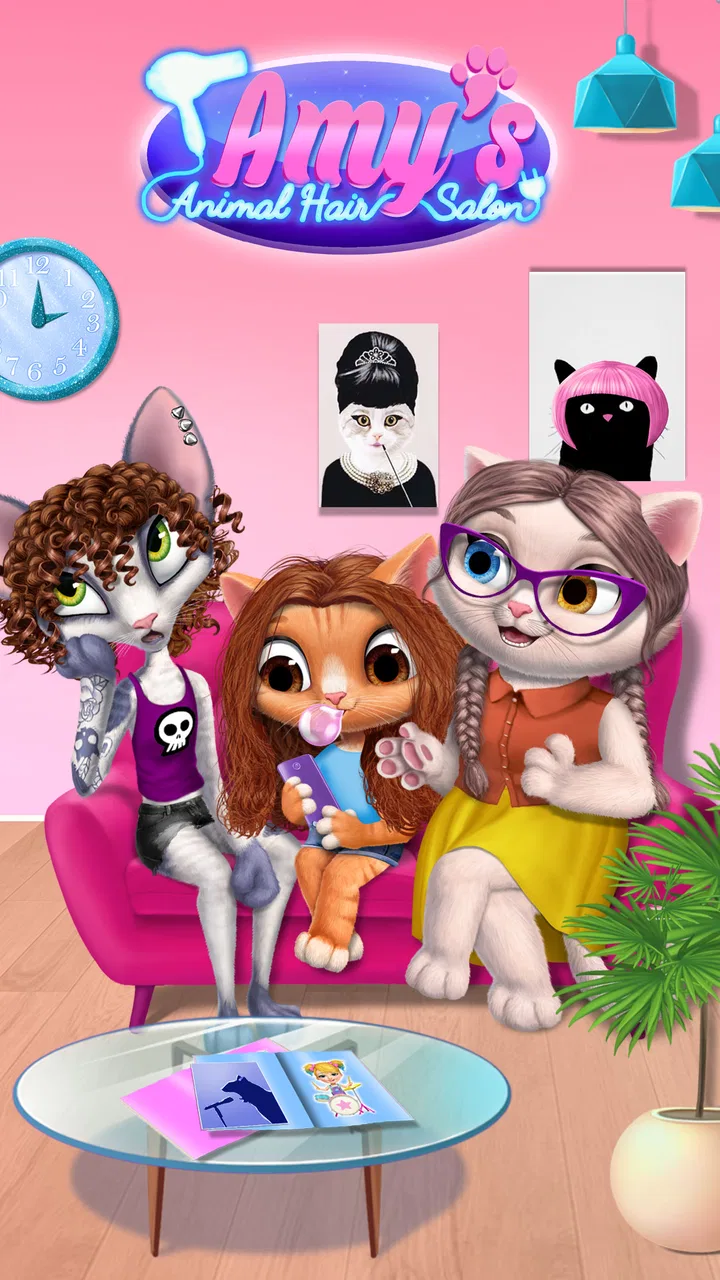
Amy's Animal Hair Salon
- 3.8
- Rating
- 10.00M
- Installs
- Free
- Price

 Analysis by App-foxy
I approached Amy's Animal Hair Salon as a small, playful grooming game rather than as a serious lesson in animal care. That distinction matters. Its central idea is simple: children take on the role of a pet stylist and make animals look ready for the salon. The appeal comes from turning ordinary grooming actions into a gentle sequence of choices, taps, and visual changes.
Developed by TutoTOONS, this free educational game is aimed at Everyone and is available for Android devices running version 6.0 or later. It has reached over 10 million installs, which tells me it has found a broad audience among families looking for a light activity rather than a demanding game. The current version is 4.0.50129, while the average score sits at 3.8 from around 15,000 ratings. Those figures suggest a popular but not universally loved experience, and after spending time with it, I can understand both sides.
Why the grooming role is the real attraction
The strongest capability here is the ability to let a child feel responsible for a pet’s appearance. Instead of simply watching an animated animal, the player becomes the person deciding how the grooming session should progress. That small shift—from spectator to stylist—is what gives the game more value than a basic cartoon animation.
You May Also Like

 Blood Strike: 2.5 Anniversary
Blood Strike’s Loadouts Turn Every Drop Into a Tactical Gamble
A close look at Blood Strike’s custom loadouts: how fast access to signature weapons reshapes its battle royale rhythm, rewards preparation, and narrows the gap between fights.

 Pandora - Music & Podcasts
Pandora’s Music Is Easy to Start, but Harder to Recover
Pandora’s strength is its low-effort path from a seed to a station. Its weak spot is how much confidence it asks you to place in connection, setup, and quiet recovery.

 8 Ball Pool
 Is Built on Rivalries, Rematches, and Routine
A close look at the rivalries, rematches, shared routines, and unanswered safety questions that turn a quick pool match into a persistent mobile community.

 Samsung Music
’s Quiet Strength Is Playing What You Already Own
Its reach comes less from spectacle than from dependable access to a personal library. That simplicity is both the app’s strongest retention engine and its ceiling.

 AccuWeather: Weather Radar
AccuWeather Review: A Quick, Clear Forecast for Everyday Decisions
For everyday plans, the best forecast is the one you can understand quickly. AccuWeather makes rain timing, radar, and local conditions easy to act on, with a few trade-offs.

 Hill Climb Racing
Why Hill Climb Racing Still Turns Crashes Into One More Run
A tiny car, a bumpy hill and one more upgrade: Hill Climb Racing keeps resurfacing because its simple chaos makes every near-miss feel personal.
More From Our News Desk



I found the salon theme especially effective for younger players who enjoy pretend play. A child can imagine that each animal has arrived needing attention, and the player’s job is to help it leave looking cared for. The activity does not depend on complicated rules, fast reactions, or deep reading. It uses a familiar situation and makes the player’s actions visible through the animal’s changing appearance.
That makes the game educational in a practical, early-learning sense rather than an academic one. It encourages following a sequence, noticing visual differences, making choices, and completing a task. I would not use it as a replacement for a structured lesson about real pet hygiene, but it can support conversations about gentle handling, cleanliness, and looking after animals.
The key benefit is the feeling of completing a care routine. Children are not merely collecting points or trying to defeat an opponent. They are working toward a visible result: a pet that looks ready after its salon visit. For a young player, that before-and-after change can be satisfying enough to encourage patience and attention.
How the salon idea works during play
In practice, the experience is built around interaction with the animal and the styling process. The player is guided toward actions that make sense in a beauty salon, then gets to see the effect of those actions. This direct connection between touch and result is easier for a child to understand than an abstract reward system.
I also like that the theme leaves room for personal preference. A child can approach the animal as a client rather than treating every screen as a puzzle with only one correct intellectual answer. That makes it suitable for short, relaxed sessions after school, during travel, or while an adult is nearby. It is the kind of game a child can pick up without first learning a large collection of controls.
For parents, the useful point is that the game creates a natural opening for conversation. You can ask why an animal might need grooming, whether it is comfortable, or what it means to care for a pet. The app itself should not be treated as a complete guide to animal welfare, but its pretend-salon setting can make those questions feel natural instead of forced.
One practical tip is to let the child explain the order of the salon visit in their own words. Asking “What should we do next?” turns passive tapping into a small planning exercise. Another is to encourage the child to describe the final look and explain why they like it. That adds language practice and decision-making without changing the game.
The visual feedback also makes the game approachable for children who are not yet confident readers. The main appeal is communicated through characters, objects, and changes on screen rather than through long blocks of text. That said, an adult may still need to help at first, particularly if the child is unfamiliar with touch controls or expects every action to behave like a real salon tool.
A realistic everyday use case
Imagine a child waiting for a family appointment or winding down before dinner. They may want something more interactive than a video but may not have the patience for a platform game. This is where the salon format works well. A short session can provide a clear beginning, a set of grooming decisions, and a finished pet without requiring a long commitment.
I would also consider it useful for a child who repeatedly asks to play with a family pet’s appearance. The game offers a safer pretend outlet than allowing a young child to experiment with brushes, water, or styling products on a real animal. An adult can use the virtual salon to explain that real pets have boundaries and that grooming should be done carefully and appropriately.
It can work during shared play, too. An older sibling or parent can take turns with the child, discussing which style looks best and why. The game is more valuable in that setting because the conversation adds context that a solo session may lack. Left entirely alone, a child may simply tap through the activity quickly and move on.
I would not choose it for a long car journey if the child needs hours of varied entertainment. Its charm is concentrated in the grooming role, so repeated sessions may feel familiar sooner than a game with exploration, levels, or a larger story. It is better as a short, repeatable activity than as the only game installed on a device.
Where it differs from ordinary children’s games
Compared with action games, this one is calmer and less dependent on speed. There is no need for a child to master jumping, aiming, or rapid reactions. Compared with coloring apps, it adds a sense of process: the child is not only decorating a picture but participating in a themed service. Compared with educational quiz games, it teaches through role-play rather than direct questions and answers.
That comparison also reveals its limits. A puzzle app may offer more measurable problem-solving practice, while a drawing app may provide greater creative freedom. A dedicated pet-care simulation may feel deeper for children who want feeding, training, or ongoing responsibility. Amy's Animal Hair Salon is strongest when the child wants the immediate satisfaction of styling an animal, not when they are looking for a broad virtual-pet world.
The game’s educational value is therefore tied to the way it frames grooming. If a child enjoys pretend salons, animals, and visual makeovers, the format can hold attention. If they prefer stories, competition, construction, or open-ended drawing, the same simplicity may feel limiting. I would judge it by that specific interest rather than by expecting every child to respond to the animal theme.
The tradeoffs parents should understand
The biggest friction is the balance between being free and containing optional purchases. The game costs nothing to start, but in-app items range from $3.99 to $159.99 per item. That is a wide range, so I would review purchase controls before handing the device to a child. Even when a child only wants to continue styling animals, an attractive locked option can create pressure to ask for a purchase.
This does not automatically make the game a poor choice, but it changes how I would introduce it. I would set clear expectations before play and make sure the child understands which parts are available without buying anything. On a shared family device, I would also avoid leaving payment confirmation within easy reach. The safest experience is one where the adult has already decided how optional spending will be handled.
The rating of 3.8 is another useful signal. It is not a reason to reject the game, but it suggests that the experience has rough edges for some families. In my view, part of that comes from the narrow focus: children who love the salon routine may be happy, while others may quickly want more variety. A popular download count does not guarantee that every child will find the same level of replay value.
There is also a difference between virtual grooming and real animal care. The game makes the process feel tidy and playful, while real pets can be nervous, resistant, or uncomfortable. I would avoid presenting the app as a realistic training tool. Its best use is imaginative play with a gentle care theme, supported by an adult who can explain where pretend play stops and responsible handling begins.
Another tradeoff is that the game’s accessibility can make it feel shallow to older children. A child who already reads confidently and enjoys complex challenges may finish the available routine quickly. For that audience, a more involved management or creative game may provide better long-term value. The Everyone rating makes it broadly approachable, but it should not be confused with being equally engaging for every age within that group.
Small ways to get more from each session
I found that the best approach is to treat each play session as a mini story. Before starting, ask the child what kind of client the animal is and what the animal might need. During the activity, ask them to notice the order of actions. At the end, let them describe the result. This turns a few minutes of tapping into sequencing, vocabulary, and imaginative play.
A second useful approach is to give the child a limited choice rather than taking over. Instead of selecting everything for them, ask whether they want to try one look or another, then let them decide. The point is not to find the adult’s preferred result; it is to let the child practice making a harmless aesthetic decision and accepting the outcome.
For siblings, turn-taking works better than competing. One child can choose the style while the other explains the care routine, then they switch roles. That avoids turning a calm game into an argument about who controls the device. It also highlights the difference between creative preference and correct procedure.
If the child begins tapping randomly, pause and ask what they think the current action is doing. This is a simple way to check whether they are following the salon idea or merely seeking the next animation. If they cannot explain it, a short demonstration may help. If they are bored, that is useful information: the game may have reached the limit of its appeal for them.
Who is most likely to enjoy it
I would recommend this game most strongly to younger children who enjoy animals, make-believe beauty play, and visible transformations. It is also a reasonable first game for a child who needs simple interactions and a low-pressure environment. The free entry point makes it easy for a family to try, provided the adult is comfortable managing the optional purchases.
It may be especially helpful for a child who likes to imitate adult routines. A salon visit has a clear social role, recognizable tools, and a satisfying finish. The game lets the child rehearse that role without the mess or unpredictability of a real grooming session. Used alongside conversation, it can encourage care-oriented thinking without pretending to teach every detail of pet ownership.
I would skip it if the child is looking for strategy, a substantial story, competitive play, or a large world to explore. I would also choose something else if the main goal is formal learning, because the educational elements here are informal and tied to role-play. A drawing tool may be a better option for unrestricted creativity, while a deeper simulation may suit a child who wants ongoing responsibility for a virtual animal.
Device compatibility is fairly approachable for families using Android hardware, since the game works from Android 6.0 onward. Still, I would check the actual device experience before promising it as a favorite, especially on an older phone or tablet. Children notice delays and awkward controls quickly, and a simple game has less complexity to distract from those problems.
My final take on the salon experience
After looking at what the game is trying to do, I see Amy's Animal Hair Salon as a focused pretend-play activity with a useful care theme. It succeeds when a child wants to become the stylist, make visible changes, and finish with a pet that feels personally prepared. It does not need complicated mechanics to deliver that particular pleasure.
Its weaknesses are equally clear. The routine may not stay fresh for children who need constant novelty, and the optional purchase range means adults should establish safeguards before play. The game also works best when someone helps connect virtual grooming with real-world kindness and responsible pet handling.
For the right child, I think it is worth trying because it is easy to understand, gentle in tone, and more interactive than simply watching an animal character. I would present it as a short creative game, not as a complete educational course or a realistic pet-care simulator. With that expectation, it can be a pleasant choice for quiet play and a surprisingly good prompt for talking about care, choices, and treating animals gently.
FAQs for Amy's Animal Hair Salon
01What is the main objective of Amy's Animal Hair Salon?
Amy's Animal Hair Salon is a creative app designed for children, where they can express their imagination by styling various adorable animal characters. The main objective is to provide a fun and engaging experience, allowing users to wash, cut, style, and color the hair of different animals while exploring their creativity in a virtual salon environment.
02Is Amy's Animal Hair Salon suitable for all ages?
The app is primarily designed for children ages 4 and up, offering a user-friendly interface and simple controls that are easy for young players to navigate. However, older kids and even adults who enjoy casual, creative games may also find it entertaining. Parental guidance is recommended for younger children to enhance their experience.
03Does Amy's Animal Hair Salon contain in-app purchases or ads?
Yes, Amy's Animal Hair Salon includes in-app purchases and ads. While the basic version of the app is free, additional features, characters, and tools can be unlocked through purchases. Ads may be present, but they can often be removed by upgrading to a premium version. Parents should be aware of these elements before downloading.
04What devices are compatible with Amy's Animal Hair Salon?
Amy's Animal Hair Salon is available for both Android and iOS devices. It requires Android version 5.0 or higher and iOS version 10.0 or later. It's optimized for both phones and tablets to provide the best user experience. Ensure your device meets these requirements for smooth gameplay.
05How does Amy's Animal Hair Salon support child development?
The app supports child development by encouraging creativity, improving fine motor skills, and enhancing problem-solving abilities. Through interactive gameplay, children develop hand-eye coordination and learn about different colors and styles. It's a great way for kids to express themselves artistically while having fun in a playful, digital environment.
Pros
- Engaging and colorful graphics
- Wide variety of animal characters
- User-friendly interface
- Educational gameplay elements
- Regular updates with new features
Cons
- In-app purchases can add up
- Requires internet connection
- Limited free content
- Ads may disrupt gameplay
- Some features are repetitive

Amy's Animal Hair Salon
Gallery